 Annual Report 2020-2021 (8,767 KB)

Sharilyn J. Ingram
Chair, Canadian Cultural Property Export Review Board
344 Slater Street, 15th Floor, Suite 400
Ottawa, ON K1A 0E2
The Honourable Pablo Rodriguez
Minister of Canadian Heritage
15 Eddy Street
Gatineau, QC K1A 0M5
Dear Minister,
It is an honour to present the annual report of the operations of the Canadian Cultural Property Export Review Board (CCPERB) for the fiscal year 2020-2021.
During a year that was indelibly defined by the global COVID-19 pandemic, the exchange of cultural property naturally receded as a priority, as matters of public health became the common cause for all levels of government, for collecting institutions, and for individual Canadians alike. However, with the advance of vaccination efforts in early 2021 and the inevitable return to in-person social and cultural activities, more than ever we are reminded of how encounters with art, historical artefacts, archival records, and other forms of cultural property can provide a vital sense of human connection that transcends our immediate time and place. Certainly as more routine pursuits are reestablished, Canada’s galleries, museums, libraries, archives, and other cultural institutions will reemerge as vibrant gathering places, inspiring individual and collective discovery, creativity, and reflection.
In support of that eventuality, CCPERB continued during 2020-2021 to fulfil its duties as established in the Cultural Property Export and Import Act. Even as CCPERB adapted to the necessity of remote operations and other innovative approaches to our work, the Board reviewed 480 applications for certification, representing 1577 objects, collections, or groups of objects acquired by 84 diverse collecting institutions all across Canada.
This work ensured that donors and vendors continued to have access to the incentives established in the Act, while also supporting the ongoing efforts of Canadian cultural property organizations to develop their collections. These efforts in turn will ensure that cultural property of outstanding significance will continue to be publicly accessible to Canadians in the years to come.
Perhaps the pandemic’s most conspicuous influence on CCPERB’s duties was the near-absence of requests for review of refused cultural property export permits. One request was received in January 2021 but was subsequently withdrawn by the applicant. While the number of requests received by CCPERB typically fluctuates from year to year, the fact that no such requests were submitted to CCPERB in 2020-2021 is indicative of the unique circumstances that prevailed during the COVID-19 pandemic, when non-essential international travel and trade largely were suspended. CCPERB anticipates that the export of cultural property will resume as global conditions once again are favorable to these markets, with a corresponding increase in requests for CCPERB to review refused export permits anticipated in the coming years.
Individually as Board members and collectively as an organization, CCPERB was made acutely aware of how our mandate truly is part of an interdependent system, both nationally and internationally, of acquisition, preservation, exchange, and access to cultural property. Within Canada, the steady influx of applications for certification of cultural property testified to the unabated generosity of donors, the perseverance among collecting organizations working in the public interest, and the undiminished public appreciation for cultural property in all its forms. CCPERB’s own sense of purpose and pride in our work under the Cultural Property Export and Import Act was unwavering, which I hope is amply conveyed in the following report on CCPERB’s operations for the fiscal year 2020-2021.
Sincerely,

Sharilyn J. Ingram, Chair
Canadian Cultural Property Export Review Board
The Canadian Cultural Property Export Review Board (CCPERB) performs a vital function for parties seeking review of an application for a cultural property export permit, as well as for cultural property donors and collecting institutions seeking to enhance public collections in an environment of limited acquisition budgets and a growing international interest in Canadian cultural property.
This report provides an account of CCPERB’s operations for the fiscal year 2020-2021, and features statistics to illuminate CCPERB’s duties relating to cultural property export and the issuance of tax certificates for cultural property of outstanding significance, generally referred to as “certification” of cultural property.
This report also highlights updates to CCPERB’s policies and procedures, stakeholder engagement initiatives, and other milestones that defined CCPERB’s work throughout the 2020-2021 fiscal year, including the Board’s operational adaptations in the context of the COVID-19 pandemic.
The Canadian Cultural Property Export Review Board is an independent, quasi-judicial administrative tribunal established under the Cultural Property Export and Import Act. CCPERB meets four times per year in order to:
CCPERB reports to Parliament through the Minister of Canadian Heritage, but operates at arm’s length from its portfolio department to ensure the autonomy of its decision-making powers.
The Cultural Property Export and Import Act (the Act) establishes a system of controls for the export from Canada of cultural property, and supports the prevention of illicit international traffic in cultural property. The intent of the Act is to balance the rights of cultural property owners with the civic good derived from public access to objects of outstanding significance and of national importance.
Specific elements of the legislation are administered or enforced by other federal organizations, including:
As part of its system of protections, the Act establishes a Canadian Cultural Property Export Control List, which identifies objects or classes of objects, the export of which is necessary to control in order to preserve the national heritage in Canada. Subsection 4(2) of the Act identifies inclusions in the Control List as follows:
CCPERB made no (0) review for applications review for export permits and no (0) fair-cash offer determinations.
| Number of applications reviewed | 480 |
|---|---|
| Number of objects reviewed - Includes grouping of objects and Collections | 1577 |
| Number of designated organizations - that submitted applications | 84 |
| Tax certificates issued to donors | 421 |
| Applications approved | 88% |
|---|---|
| Total fair market value determined | $93M |
| Certified at the proposed value | 56% |
| Certified at a higher value | 8% |
| Certified at a lower value | 24% |
| Put on hold or deferred | 10% |
| Refused | 2% |
| Objects of Fine Arts | 84% |
|---|---|
| Archival Material | 11% |
| Objects of Applied and Decorative Arts | 3% |
| Other | 2% |
The Act describes the steps and criteria used to establish whether an object that is included in the Control List may be issued an export permit. When an application for a cultural property export permit is refused by a permit officer of the Canada Border Services Agency (based on the advice of an expert examiner), the applicant may request a review by CCPERB. In these cases, CCPERB first must determine if the object is included in the Control List, and whether the object meets the criteria for “outstanding significance” and “national importance” set out in the Act, specifically:
If CCPERB determines that an object meets the above criteria, it will then form an opinion as to whether an institution or public authority in Canada might make a fair offer to purchase the object within six months after the date of its decision in the proceeding.
If so, CCPERB may establish a temporary export delay period of two to six months. These temporary export delay periods provide Canadian institutions with an opportunity to acquire significant cultural property facing permanent export from Canada.
As a consequence of the COVID-19 pandemic, which had an unmistakable influence on virtually every sector of international commerce, cultural property export was among the disrupted systems. In January 2021, CCPERB received one request for review of a cultural property export permit; however, this request subsequently was withdrawn. As a result, CCPERB conducted no (0) reviews of refused export permits during 2020-2021. While the number of reviews conducted by CCPERB may fluctuate significantly from year to year, the total for this fiscal year is indicative of the unique circumstances that prevailed internationally, as non-essential travel and trade largely were suspended.
When an object is subject to a temporary export delay period established by CCPERB, the export permit applicant may reach an agreement with an organization to purchase the cultural property. If these parties cannot reach an agreement, either party may request that CCPERB determine what would constitute a fair cash offer.
While the cultural property owner is under no obligation to accept any purchase offer, the fair cash offer determination is intended to facilitate an exchange where negotiations have stalled. If the owner rejects an offer that is equal to or greater than the fair cash offer amount determined by CCPERB, then no export permit will be issued for a period of two years from the date of the original notice of refusal. At the end of the two-year moratorium, the permit applicant may submit a new application.
In 2020-2021, CCPERB made no (0) fair-cash- offer determinations.
The Cultural Property Export and Import Act provides a system of incentives designed to help preserve significant cultural property in Canada by offering tax certificates to donors or vendors who reach a disposition agreement with a designated museum, gallery, library, or archive.
In some cases, applications may be put on hold or otherwise deferred, or they may be subject to a request for redetermination; these applications may be tabled at more than one meeting during a fiscal year, or they may be carried over from a previous fiscal year.
Although these totals are indicative of a significant volume of applications and of objects of cultural property considered for certification by CCPERB, these totals also were informed by the capacity of organizations to process acquisitions and prepare applications due to the disruptive nature of the COVID-19 pandemic.
The Cultural Property Export and Import Act uses the term “object(s)” to refer to all forms of cultural property disposed of, or proposed to be disposed of, to an institution or a public authority designated under the Act.
Objects may include, for example, archival cultural property, books and ephemera, scientific specimens, objects of natural history, fine art, and any other materials recognized as cultural property under the Act.
| Number | Percentage | ||
|---|---|---|---|
*If an application contains objects of various classes, an applicant may identify more than one cultural property group for a single application. Consequently, the total number of cultural property groups identified by applicants (484) is slightly higher than the total number of applications that received a decision (480). |
|||
| Class 1 | Objects of Natural History (including fossils, minerals and other natural history objects) and Archeology | 2 | 0.4% |
| Class 2 | Objects of Material Ethnographic Culture | 2 | 0.4% |
| Class 3 | Military Objects | 0 | 0% |
| Class 4 | Objects of Applied and Decorative Arts | 16 | 3% |
| Class 5 | Objects of Fine Arts | 408 | 84% |
| Class 6 | Scientific or Technological Objects | 2 | 0.4% |
| Class 7 | Archival Material | 54 | 11% |
| Class 8 | Musical instruments | 0 | 0% |
| Class 9 | Audiovisual collections (film, video, new media, including digital) | 0 | 0% |
| Total | 484 | 100% | |
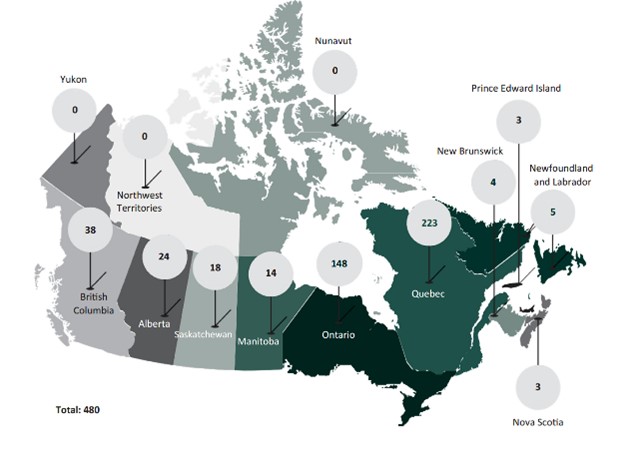
| Province/Territory | Number of applications |
|---|---|
| British Columbia | 38 |
| Alberta | 24 |
| Saskatchewan | 18 |
| Manitoba | 14 |
| Ontario | 148 |
| Quebec | 223 |
| New Brunswick | 4 |
| Newfoundland and Labrador | 5 |
| Prince Edward Island | 3 |
| Nova Scotia | 3 |
| Yukon | 0 |
| Northwest Territories | 0 |
| Nunavut | 0 |
| Total | 480 |
| Decision | Number | Percentage % | Total Fair Market Value | Approximate forgone Federal tax revenue |
|---|---|---|---|---|
1 Includes decisions where the average of more than one appraisal is taken as the fair market value. 2 If CCPERB needs additional information before making a decision, it will put the application on hold. CCPERB may also defer an application for administrative purposes. The total cited here represents the number of on hold or deferred files at the end of the fiscal year. 3 If CCPERB concludes that an object does not meet the criteria for outstanding significance it will refuse the application. 4 If CCPERB determines that it has no jurisdiction to proceed with the review of an application (for example, if CCPERB is not satisfied that the donor or vendor was the owner of the object at the time of donation or sale), the application is deemed inadmissible. |
||||
| Certified at the proposed value1 | 269 | 56% | $44,446,069.78 | $12,889,360.23 |
| Certified at a lower value | 113 | 24% | $38,630,677.54 | $11,202,896.49 |
| Certified at a higher value | 39 | 8% | $9,779,065.99 | $2,835,929.14 |
| Put on hold or deferred2 | 49 | 10% | NA | NA |
| Refused3 | 10 | 2% | NA | NA |
| Inadmissible4 | 0 | 0% | NA | NA |
| Total | 480 | 100% | $92,855,813.31 | $26,928,185.86 |
As part of the certification process, CCPERB makes determinations with respect to the fair market value of the cultural property put forward for certification. Donors or vendors who do not agree with a CCPERB determination of fair market value may request a redetermination within 12 months of the date of CCPERB’s decision. Subsequently, donors or vendors who do not agree with the redetermination of fair market value may appeal the decision to the Tax Court of Canada within 90 days after the day on which the Cultural Property Income Tax Certificate is issued.
In 2020-2021, CCPERB reviewed 8 requests for a redetermination; among these, none was appealed to the Tax Court of Canada. When a redetermination is made, the original tax certificate is nullified and replaced by a new tax certificate in the amount of the redetermined fair market value. Among the 8 redetermination decisions made by CCPERB in 2020-2021, 3 tax certificates from fiscal year 2020-2021 were nullified and replaced, and 5 tax certificates from previous fiscal years were nullified and replaced.

A Canopy of Maple Leaves, the Patterned Strings of a Koto, by Utagawa Kunisada (Toyokuni III), 1847-1852.
Montreal Museum of Fine Arts, Inv. 2020.286.1-3, photo MMFA.
Gift of Dr. Jonathan L. Meakins and Dr. Jacqueline McClaran.
Certified by CCPERB in 2021.

An Eastern Genji Crossing the Ōi River, by Utagawa Kunisada (Toyokuni III), 1851.
Montreal Museum of Fine Arts, Inv. 2020.287.1-3, photo MMFA.
Gift of Dr. Jonathan L. Meakins and Dr. Jacqueline McClaran.
Certified by CCPERB in 2021
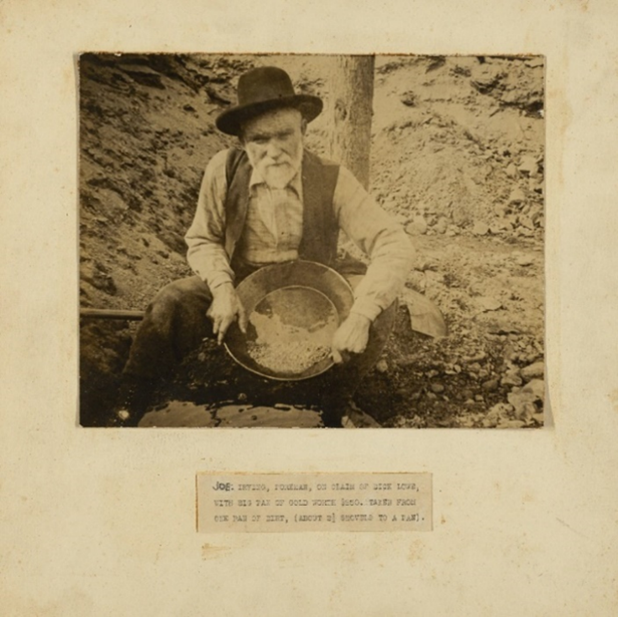
Joe Irving, Foreman, on claim of Dick Lowe, with big pan of gold worth $850. Taken from one pan of dirt, (about 2 1/2 shovels to a pan), 1898, by L. G. Grant, part of the Phil Lind Klondike Gold Rush Collection.
University of British Columbia Libraries, Rare Books and Special Collections, RBSC-ARC-1820-PH-1671.
Certified by CCPERB in 2020.
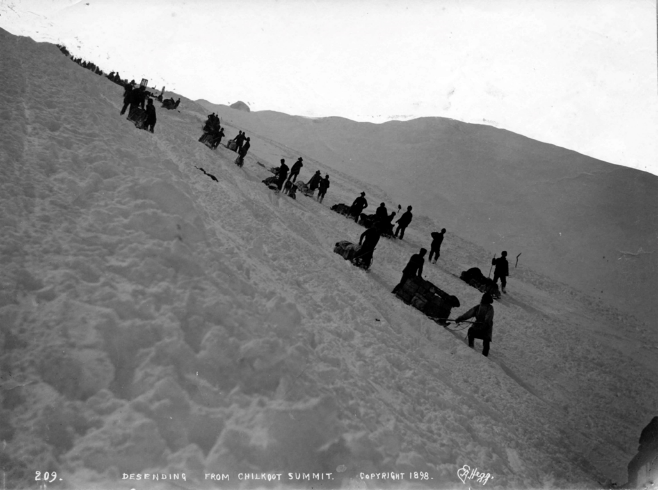
Descending from Chilkoot Summit, 1898, by Eric A. Hegg, part of the Phil Lind Klondike Gold Rush Collection.
University of British Columbia Libraries, Rare Books and Special Collections,
RBSC-ARC-1820-PH-0094. Certified by CCPERB in 2020.
The 2020-2021 fiscal year was defined by the historic conditions and mitigating actions that were compelled by the international COVID-19 pandemic. No dimension of Canadian life or society remained untouched by this experience, and CCPERB, like other administrative tribunals, was challenged to continue to perform its duties while adapting to safe and secure remote operations. Guided by federal, provincial, and municipal health measures, and with the conscientious assistance of the Administrative Tribunals Support Service of Canada, CCPERB ensured that the health and well-being of members, staff, and the stakeholder community were the Board’s top priority throughout 2020-2021.
In early 2020, CCPERB modified its operations as part of government-wide measures to address the COVID-19 pandemic. These measures included cancelling CCPERB’s March 2020 quarterly meeting and postponing the deadline to submit applications for the June 2020 meeting. Applications submitted for the March meeting were brought forward to the June meeting, and other applications received through July 10, 2020 were tabled at the September 2020 meeting. During this time, CCPERB implemented and refined its approach to remote meetings, which were maintained throughout 2020-2021. CCPERB updated its website and distributed communications regularly in order to keep applicants and other stakeholders informed of these measures, as well as to ensure the Board could carry out its duties as efficiently as possible.
CCPERB approved and adopted an updated Guide for Monetary Appraisals in November 2020.
The Guide provides instructions for applicants and appraisers regarding the information standards and recommended format for monetary appraisals prepared in support of applications for certification.
Subsection 32(1) of the Cultural Property Export and Import Act provides CCPERB with jurisdiction to determine whether cultural property is of outstanding significance and, if so, also to determine the cultural property’s fair market value for the purpose of issuing a tax certificate. In that context, the objective of the Guide is the same for individual objects such as a tapestry, or for diverse groupings of objects such as an archival fonds: the Guide outlines specific approaches and general strategies to ensure appraisers cite market data and provide a reasoned justification upon which CCPERB can make a determination of fair market value, as required under the Act.
Updates to the Guide also were intended to address specific recurring issues that CCPERB encountered in making determinations of fair market value for some applications for certification, in particular a subset of applications relating to archival cultural property. Accordingly, CCPERB consulted with national and international archival organizations and other stakeholders in order to inform the monetary valuation of archival cultural property; additional information about the scope of stakeholder engagement is provided below, under “Stakeholder Engagement”.
CCPERB does not regard the Guide for Monetary Appraisals—or any of the supporting materials it prepares to assist applicants—as an immutable document. CCPERB is open to hearing from stakeholders in order to continuously improve and clarify its processes where it is possible to do so under existing law.
Recognizing the need for consistency in the treatment of appraisals of all types of cultural property, CCPERB began a process of consultation regarding the Guide for Monetary Appraisals following the publication of the initial version of the Guide in late 2019. Beginning in the fall of 2019 and continuing throughout the 2020-2021 fiscal year, CCPERB engaged in discussions with national and international organizations to gain insight into practices relating to the valuation of archival cultural property. This included meetings with representatives of Library and Archives Canada, the Canadian Council of Archives (CCA), and consultations with Arts Council England, The National Archives (UK), the National Library of Australia, the Australia Department of Communication and the Arts, the United States Internal Revenue Service, the Harry Ransom Center, and the Antiquarian Booksellers of America.
Through April 2020, CCPERB solicited comments from approximately 20 Canadian specialists active in the field of cultural property appraisal, including rare book dealers, members of the Canadian Chapter of the International Society of Appraisers, members of the Art Dealers Association of Canada Appraisal Committee, and independent appraisers.
In July 2020, CCPERB circulated a revised draft of the Guide to archival organizations and other stakeholders, as well as to any other organization or individual who requested a copy. CCPERB solicited input from applicants whose applications for certification had been deferred pending finalization of the Guide, and from associations and other stakeholders that represented archival institutions, archivists, and appraisers of archival fonds.
Throughout the summer and fall of 2020 CCPERB received comments from individuals, institutions and other organizations such as the Canadian Association of Research Libraries, the Association of Canadian Archivists (ACA), Bibliothèque et Archives nationales du Québec, the Canadian Historical Association, the University of Toronto, the Art Gallery of Ontario, the Council of Provincial and Territorial Archivists, the Canadian Council of Archives, the current and a former Librarian and Archivist of Canada, as well as other individual archivists and appraisers. CCPERB and its Secretariat also convened meetings with representatives of CCA, ACA, the University of Toronto, and Queen’s University in order to receive direct feedback.
It was evident to CCPERB that the submissions of the professionals and institutions who commented on the draft guide reflected extensive experience with applications for certification and for monetary appraisals. CCPERB carefully considered each submission and each recommendation contained therein. CCPERB discussed those submissions and recommendations at length and, where possible, CCPERB amended the draft guide taking into account the submissions and recommendations. In December 2020, CCPERB issued a statement to archival stakeholders in order to summarize the principal recommendations of the archival community, to identify the recommendations that CCPERB was not able to adopt, and to explain why with reference to statutory provisions, jurisprudence and requirements of administrative law.
The full Communication to Archival Stakeholders is available on the CCPERB website.
CCPERB consists of a Chairperson and up to nine other members appointed by the Governor in Council on the recommendation of the Minister of Canadian Heritage.
Members are selected for their expertise in a range of fields relating to cultural property, including professional expertise gained at art galleries, museums, archives, libraries or other collecting institutions in Canada, or as dealers in or collectors of art, antiques or other objects that form part of the national heritage.
Specifically, section 18 of the Cultural Property Export and Import Act establishes membership as follows:
Under the Act, decisions must be made by no fewer than three members, at least one of whom was appointed under the institutional category, and at least one of whom was appointed under the dealer/collector category.

CCPERB Board Members:
From left to right, top row: Laurie Dalton, Monte Clark, Glen A. Bloom, Paul Whitney, Pierre-François Ouellette
Bottom row: Madeleine Forcier, Sharilyn J. Ingram, Patricia Feheley, Theresa Rowat
Absent: Dana Soonias
The following table identifies members with active terms during 2020-2021.
| Member Category | Members in 2020-2021 | Current term |
|---|---|---|
| Public at large | Sharilyn J. Ingram Chair Retired academic and museum professional Grimsby, ON |
June 2020 – June 2023 |
| Glen A. Bloom Retired partner at Osler, Hoskin & Harcourt LLP Ottawa, ON |
March 2020 – March 2023 | |
| Collecting institution | Laurie Dalton Director/curator, Acadia University Art Gallery, Adjunct professor, Dept. of History and Classics, Acadia University Wolfville, NS |
January 2021 – January 2024 |
| Theresa Rowat Director, The Archive of the Jesuits in Canada Montreal, QC |
March 2021 – March 2022 | |
| Dana Soonias Indigenous Cultural Centre Executive |
June 2018 – Resigned in July 2020 | |
| Paul Whitney Library and policy consultant, writer, book and art collector Vancouver, BC |
February 2021 – February 2024 | |
| Dealer/collector | Monte Clark Owner/Director, Monte Clark Gallery Vancouver, BC |
February 2018 – February 2021 |
| Patricia Feheley Director, Feheley Fine Arts Toronto, ON |
May 2021 – May 2023 | |
| Madeleine Forcier Director, Graff Gallery Montreal, QC |
May 2021 – May 2022 | |
| Pierre-François Ouellette Director, Pierre-François Ouellette art contemporain Montreal, QC |
January 2018 – January 2021 |
CCPERB meets four times per year. At these meetings, CCPERB considers requests for the review of cultural property export permits, and applications for the certification of cultural property.
Meeting dates generally are posted to the CCPERB website a minimum of one year in advance. During the 2020-2021 fiscal year, CCPERB modified its previously announced quarterly meeting schedule in order to adapt to the new remote meeting measures required as a result of the COVID-19 pandemic, as well as to ensure CCPERB continued to process applications as efficiently as possible following the cancellation of the March 2020 meeting. Specifically, CCPERB convened one additional meeting to review files on November 10, 2020 and, throughout the fiscal year, instituted a monthly teleconference in order to address other business related to the duties set out in the Cultural Property Export and Import Act.
CCPERB’s amended quarterly meeting scheduled during 2020-2021 was the following:
As of the quarterly meeting in March 2021, CCPERB began to publish a Quarterly Report on its website, in order to provide the public with a statistical summary of formal business conducted during the meeting.
The Secretariat to CCPERB is part of the Administrative Tribunals Support Service of Canada (ATSSC). The Secretariat supports CCPERB and its applicants by:
For questions about CCPERB operations or information contained in this Annual Report, please contact the Secretariat at:
Secretariat to the Canadian Cultural Property Export Review Board
344 Slater Street, 15th Floor, Suite 400
Ottawa, Ontario K1A 0E2
