 Annual Report 2023-2024 (5,886 KB)

Joanne Stober
Chairperson, Canadian Cultural Property Export Review Board
344 Slater Street, 15th Floor, Suite 400
Ottawa, ON K1A 0E2
The Honourable Marc Miller
Minister of Canadian Identity and Culture
15 Eddy Street
Gatineau, QC J8X 4B3
Dear Minister,
It is an honour to present my first Annual Report as Chairperson of the Canadian Cultural Property Export Review Board (CCPERB). This report highlights the operations of the Review Board for the fiscal year 2023-2024.
CCPERB is an independent administrative tribunal established under the Cultural Property Export and Import Act. Our statutory mandate is to assess whether cultural property intended for export is of outstanding significance and national importance, and to determine if such property should be subject to a temporary export delay to allow Canadian institutions the opportunity to acquire it for public benefit. The Review Board also certifies cultural property for tax purposes, thereby encouraging public donations to Canadian heritage institutions.
This year has been transformative, marked by renewed leadership, enhanced processes, and a deep commitment to improving the Board’s efficiency and accessibility. The Review Board welcomed three new members and a returning member, creating a composition that reflects geographic, linguistic, and professional expertise. This diverse representation has strengthened CCPERB’s ability to address complex issues with efficacy and deep insight.
The Review Board reviewed seven (7) export permit requests and held four (4) hearings to determine the issuance of export permits. Of these seven (7) applications reviewed, the Board directed that an export delay be established in six (6), and one (1) object was subsequently acquired by a Canadian institution.
The Review Board welcomes the opportunity to review export permits and continues to refine the process in alliance with the Cultural Property Export and Import Act and guided by the principles of United Nations Declaration on the Rights of Indigenous Peoples (UNDRIP), the Board has refined its decision-making framework to accommodate the diversity of cultural objects it evaluates. This flexibility ensures fairness and adaptability in applying the legislation.
The Review Board always strives to increase the efficiency of its operations and streamline the application process through clearer, more accessible guidelines. The Board's Secretariat supports this effort by providing daily assistance to applicants and engaging in outreach initiatives. As its heads into the new fiscal year, the Review Board is committed to maintaining a dialogue with stakeholders and adjusting its processes regarding review of applications to remain fair and accessible to all.
Engagement with stakeholders has been a key focus of the Review Board. Over the past year, the Review Board identified and addressed the causes of delays in archival case reviews. In response, it revised the Guide to Monetary Appraisals updated the definition and approach to Fair Market Value, and clarified appraisal methodologies especially focusing on archival appraisal.
These engagements and updates to procedure provide appraisers and institutions with greater transparency and consistency in the certification process. As part of this ongoing reflection, I personally engaged in consultations with several stakeholders, including the Canadian Museum Association and archival institutions and libraires whose acquisition activities have been impacted by the review of the Board's monetary appraisal guidelines in recent years. These discussions provided an opportunity to address concerns related to appraisal requirements and certification procedures.
Additionally, the time between submission and determination has been significantly reduced, minimizing unnecessary reappraisals, and enabling more efficient decision-making for stakeholders and the Canadian public.
This fiscal year, CCPERB reviewed 281 certification applications for tax purposes and, more impressively, of the applications approximately 932 objects or collections of objects were certified for a total fair market value of $81,000,000.
As well, over the course of the fiscal year, the Review Board considered its decision-making process and policies. It focused on ways to improve both efficiency and fairness in the application of the Act under which it operates. CCPERB aims to maintaining a flexible decision-making framework adapted to the diversity of the cultural objects it considers and strengthen alignment with the principles of UNDRIP.
In reporting these accomplishments, I would like to express my appreciation to my fellow Board members for their expertise and diligence in reviewing the many applications that come before us, and to the staff of the Secretariat for their ongoing commitment, unparalleled knowledge sharing and support.
Sincerely,

Dr. Joanne Stober, Chairperson
Canadian Cultural Property Export Review Board
The Canadian Cultural Property Export Review Board is mandated to protect, preserve and make cultural property accessible to the public by way of the Cultural Property Export and Import Act. Its duties fall under three mandates: the certification of cultural property of outstanding significance for tax purposes, the review of refused cultural property export permits submitted by applicants, and the determination of a fair cash offer should a sales agreement not be reached by a designated institution and a vendor.
This report provides an overview of CCPERB’s key operations and results for the 2023-2024 fiscal year, by way of statistical data for both the export of cultural property and the certification of cultural property for income tax purposes, as well as through highlights of the decisions it rendered in relation to requests for review in export matters.
Moreover, this report offers a snapshot of the Review Board’s activities, as it welcomed a significant number of new members to its fold, and, relied on the knowledge and expertise of both current and new members to identify potential gaps in its guidance and processes, always with an eye to offer quality services to applicants for both its certification and its export mandates.
The Canadian Cultural Property Export Review Board is an independent, quasi-judicial administrative tribunal established under the Cultural Property Export and Import Act. CCPERB meets four times per year in order to:
CCPERB reports to Parliament through the Minister of Canadian Heritage, but operates at arm’s length from its portfolio department to ensure the autonomy of its decision-making powers.
The Cultural Property Export and Import Act (the Act) establishes a system of controls for the export from Canada of cultural property, and supports the prevention of illicit international traffic in cultural property. The intent of the Act is to balance the rights of cultural property owners with the civic good derived from public access to objects of outstanding significance and of national importance.
Specific elements of the legislation are administered or enforced by other federal organizations, including:
As part of its system of protections, the Act establishes a Canadian Cultural Property Export Control List (Control List), which identifies objects or classes of objects, the export of which is necessary to control in order to preserve the national heritage in Canada. Subsection 4(2) of the Act identifies inclusions in the Control List as follows:
CCPERB rendered a determination in seven (7) reviews for applications for an export permit and no (0) fair cash offer determination.
| Number of applications reviewed | 281 |
|---|---|
| Number of objects reviewed - Includes grouping of objects and Collections | 932 |
| Number of designated organizations - that submitted applications | 66 |
| Tax certificates issued to donors | 260 |
| Applications approved (Remaining applications were either refused by the Review Board or remained on hold at the end of fiscal year.) | 93% |
|---|---|
| Total fair market value determined | $81M |
| Certified at the proposed value | 61% |
| Certified at a higher value | 22% |
| Certified at a lower value | 10% |
| Put on hold | 6% |
| Refused | 1% |
| Objects of Fine Arts | 89% |
|---|---|
| Archival Material | 6% |
| Objects of Applied and Decorative Arts | 3% |
| Other | 2% |
The Cultural Property Export and Import Act describes the steps and criteria used to establish whether an object that is included in the Control List may be issued an export permit. When an application for a cultural property export permit is refused by a permit officer of the Canada Border Services Agency (based on the advice of an expert examiner), the applicant may request a review by CCPERB.
In these cases, CCPERB first must determine if the object is included in the Control List, and whether the object meets the criteria for “outstanding significance” and “national importance” set out in the Act, specifically:
If CCPERB determines that an object meets the above criteria, it will then form an opinion as to whether an institution or public authority in Canada might make a fair offer to purchase the object within six months after the date of its decision in the proceeding.
If so, CCPERB may establish a temporary export delay period of two to six months. These temporary export delay periods provide Canadian institutions with an opportunity to acquire significant cultural property facing export from Canada.
In 2023-2024, CCPERB reviewed seven (7) applications for export permits and six (6) determinations found the objects to be on the Control List, and of outstanding significance and national importance. Export delays were consequently established for seven (7) objects – two (2) of which were from a single application.
In the final application, the Review Board determined that while the object was on the Control List and of outstanding significance, it did not meet the threshold for national importance. Consequently, no export delay was imposed.
The decisions, in their entirety, are published on the CCPERB website.
Application No. : 0495-23-02-03-001
On March 5, 2023, Christie’s Canada Ltd. requested a review of its application for an export permit to export the work Three Women with Pineapples, 1958, by Stanley Anita Magsaysay-Ho.
Excerpt from the CCPERB decision issued June 20, 2023:
The Applicant notes that the Object is not of outstanding significance because it reflects Philippine subject matter rather than those subjects which the artist generally chose to portray while she was resident in Canada from 1971 until her death in 2012. However, the Act does not require such specificity for an object to be of outstanding significance by reason of either its aesthetic qualities or value in the study of the arts. The Review Board finds that the artist’s incorporation of 20th- century modernism in her painterly approach is of interest in understanding the global interpretation and adaptation of modernism within regional ethnocultural contexts.
The Applicant submits sales evidence indicating that the prices of Magsaysay-Ho’s oil on canvas paintings created between 1950 and 1959 have been increasing over the past eight years, with sales of works comparable to the Object exceeding $2,000,000.00 CAN. Such results attest to the importance of the artist and the interest in collecting, exhibiting, and studying her work.
For the above reasons, the Review Board concludes that the Object is of outstanding significance for its aesthetic qualities and value in the study of the arts.
In view of the importance of the oeuvre of Magsaysay-Ho within Philippine and Southeast Asian modern art, the excellent provenance of the Object, the lack of Magsaysay-Ho’s paintings in public collections in Canada, the significant growth of the Filipino-Canadian community, as supported by recent Canadian census data, the Object’s contribution to an understanding of Canada’s diversity, specifically the Filipino diaspora, and Canadians’ understanding of twentieth- century immigrant communities and Filipino modern art, as well as the importance of acquiring such Object to advance research on these international contexts in modern art, the Review Board concludes that the Object is of such a degree of national importance that its loss to Canada would significantly diminish the national heritage.
Considering the importance of Magsaysay- Ho’s oeuvre in Asian modernist art of the latter twentieth century, as well as the interest of Canadian institutions in diversifying their collections, and having regard to the low threshold specified in the Act, the Review Board is of the view that an institution or public authority might make a fair offer to purchase the Object within six months of the Review Board’s determination in this matter.
The Board established a delay period of six months, ending December 20, 2023. CCPERB directed the Canada Border Services Agency to issue an export permit after the delay period expired.
Application No. : 0428-23-03-30-001
and
Application No.: 0428-23-05-10-001
On May 9, 2023, Sotheby’s Canada Inc. requested a review of its application for an export permit to export the work The Resurrection: Rejoicing, 1947, by Stanley Spencer, and on June 15, 2023, Sotheby’s Canada Inc. requested a review of its application for an export permit to export the work The Marriage at Cana: A Servant in the Kitchen Announcing the Miracle, 1952–1953, also by Stanley Spencer.
Excerpt from the CCPERB decision issued June 20, 2023:
These two applications contain many of the same facts. The Objects are works by the same painter, in the same medium, were executed within six years of one another have very similar provenance. Moreover, the applications were made by the same Applicant and only one written submission, applicable to both works, was provided. Consequently, the Review Board has decided to issue one decision letter in respect of the Objects. While each object was individually assessed against the requirements of the Cultural Property Export and Import Act (the Act) based on its own merits, many of the factors considered by the Review Board are applicable to both objects.
Although The Resurrection is more complex in composition than The Marriage, both are of outstanding significance due to their aesthetic quality in their own right.
With respect to the value in the study of the arts, Spencer’s biblical scenes were highly celebrated during his lifetime, and afterwards. In considering the value in the study of the arts for The Resurrection, the Review Board notes that Spencer revisited the resurrection theme in several significant and monumental works in his oeuvre. Spencer’s Resurrection series has also been the subject of academic study and research.
Similarly, The Marriage is also an outstanding example of Spencer’s biblical scenes and consequently is of outstanding significance by reason of its value in the study of the arts.
Spencer also explored themes of love and marriage in his work, as exemplified in The Marriage. In the artist’s oeuvre, The Marriage is thus a significant work in connection with this frequently visited subject matter, his personal life, thus furthering its value to the study of the arts.
The creation dates of both The Resurrection and The Marriage are also significant. The Resurrection, created in 1947, was influenced by Spencer’s time as a war artist and was painted during the aftermath and end of the Second World War. The Marriage, created in 1952–1953, as well as The Resurrection were also created during the period between 1935 and 1950 when Spencer resigned in protest from the Royal Academy of Art.
Application No. : 0428-23-02-08-001
On March 23, 2023, Sotheby’s Canada Inc. requested a review of its application for an export permit to export the work The Victim, circa 1898, by Herbert James Draper.
Excerpt from the CCPERB decision issued June 20, 2023:
The Review Board agrees with the Expert Examiner’s conclusions. In the Application for Cultural Property Export Permit, the Expert Examiner indicated that the Object is of outstanding significance by reason of its aesthetic qualities and its value in the study of the arts. The Expert Examiner stated that the Object is “significant in its composition and execution” and that it is “[a] representative example of the artist’s oeuvre, and of the Pre- Raphaelite and Neo-Classical styles.”
The Review Board notes that the work is a very good representation of an academic nude painting, as well as draughtmanship from the 19th century. Furthermore, the unclothed human body and classical draughtmanship are key elements that Draper was known for. The Review Board finds that the painting is representative of the artist’s work, who painted images of nude women and girls.
In response to the Applicant’s argument that the Object is a minor work within the artist’s oeuvre, the Review Board notes that it was created around the same time as arguably one of the Draper’s best-known works, Lament for Icarus, 1898. The Object was therefore created at one of the highest points of the artist’s career.
The Applicant also notes that the Object is mentioned little in the artist’s catalogue raisonné. While the Review Board recognizes the catalogue raisonné on the artist’s work, it does not agree that the catalogue should be the only source in which the aesthetic qualities of the work and its value in the study of arts should be assessed.
The Review Board also did not consider the fact that the Object was rejected at the Royal Academy exhibit in 1898 as an indicator of its outstanding significance, considering the politics behind exhibitions of the 19th century and the Royal Academy.
The Review Board disagrees with the Applicant that the Object is not of such a degree of national importance that its loss to Canada would significantly diminish the national heritage.
The representation of classical draughtmanship, the nude body, and the painterly approach of the Object are part of a larger art historical movement that had lasting influence on Canadian artists of the same period.
While the Review Board recognizes that works of the 19th Century are not collected by every institution in Canada, it notes that there are large museums and galleries in Canada with 19th century European and Canadian collections that have subject experts in these fields. The Review Board also recognizes the rarity of this work, in that there are none in Canadian collections, which increases the likelihood that an institution might make a fair offer on the work.
The Board established a delay period of six months, ending December 20, 2023. CCPERB directed the Canada Border Services Agency to issue an export permit after the delay period expired.
The Review Board also recognizes the important role of Spencer’s work generally in the history of British painting, and notes that Spencer’s art has been the subject of continued research.
For the above reasons, the Review Board concludes that the Objects are of outstanding significance for their aesthetic qualities and value in the study of the arts.
The Applicant does not dispute that the Objects are of national importance.
The Review Board determines that the Objects meet the criteria of national importance by reason of their rarity, provenance, and contextual associations and research value.
With respect to The Resurrection, the Review Board notes that while the Beaverbrook Art Gallery was not contacted directly in response to its media release distributed regionally that it was intending to deaccession certain works, The Resurrection was not specifically mentioned in that media release. The Applicant also confirmed that no Canadian institutions were contacted about the deaccession of The Resurrection or The Marriage.
Therefore, the Review Board is of the view that an institution or public authority might make a fair offer to purchase either of the Objects within six months of the Review Board’s determination in these matters.
In conclusion, the Review Board determines that the Objects are included in the Control List and are of outstanding significance by reason of their aesthetic qualities and value in the study of the arts and that the Objects are of such a degree of national importance that their individual loss to Canada would significantly diminish the national heritage.
The Board established a delay period of six months, ending December 20, 2023. CCPERB directed the Canada Border Services Agency to issue an export permit after the delay period expired.
Application No.: 0495-23-05-16-002
On July 4, 2023, Christie’s Canada Ltd. requested a review of its application for an export permit to export the work La lutte de Jacob et l’ange [Les Lutteurs] by Maurice Denis.
Excerpt from the CCPERB decision issued September 29, 2023:
The Applicant contends that the Object is not of “outstanding importance” as Maurice Denis is not Canadian, has no connection to Canada, and the Object is not Canadian nor Canada- inspired.
The Review Board does, however, find that the Object is of outstanding significance by reason of its aesthetic qualities and value in the study of arts.
With respect to the Object’s aesthetic qualities, the Review Board agrees with the Applicant’s submission that the Nabis played an important role in the development of French and modern art.
The Review Board, however, recognizes that it is not the artist, but rather the object that must be of outstanding significance. The Board finds that the painting, in its painterly execution, concept and technique is of outstanding significance for its aesthetic qualities.
The Review Board further recognizes the aesthetic qualities of the Object in its subject matter. The Applicant submits that it was an outlier in the artist’s work. The Review Board does not agree, and notes that Denis was often referred to as “le nabi aux belles icônes” and religion often influenced his work.
With respect to the Object’s value for the study of the arts, the Review Board notes again the important role that the Nabis played in the development of modern art. The Review Board also notes that the Object has been included in exhibitions and catalogues.
The Review Board does not agree with the Applicant’s submission that the Nabis movement was only influential in regions of France, but not Canada. The Review Board finds that the Object is of national importance for its research value, rarity, and strong contextual associations to Canada.
While the Review Board recognizes that French works of the 19th Century are not collected by every institution in Canada, it notes that there are both large and small museums and galleries in Canada with 19th century European and Canadian collections who employ experts in these fields.
The Review Board also recognizes the rarity of the Object, in that there are only four in Canadian collections, which increases the likelihood that an institution might make a fair offer on the Object.
Therefore, the Review Board is of the view that an institution or public authority might make a fair offer to purchase the Object within six months of the Review Board’s determination in this matter.
The Board established a delay period of six months, ending March 29, 2024, during which time the National Gallery of Canada acquired the Object.
Application No.: 0495-23-09-06-001
On October 20, 2023, Christie’s Canada Ltd. requested a review of its application for an export permit to export a group of 100 “mammoth plate” albumen print photographs, 1861-1870, by Carleton E. Watkins.
Excerpt from the CCPERB decision issued January 26, 2024:
The Review Board finds that the 100 photographs are a collection of associated photographs made outside the territory that is now Canada. As described by the Applicant, this specific group of prints were originally presented in a bound album. The photographs are also visually and thematically related and were made by the same creator – Watkins. As such, the Object is included in the Control List.
With respect to the Object’s aesthetic qualities, the Review Board agrees with the expert examiner that the mammoth plate albumen prints are excellent examples of Watkins’ work. Watkins is considered one of the most important American photographers of the time and the Object is a sublime testament to his skill as a photographer and printer. The excellent condition and scale of the Object further adds to its aesthetic qualities.
With respect to the Object’s value for the study of the arts, the Review Board notes Watkins’ important contribution to the field and practice of photography. A leader and pioneer in documenting the vast wilderness of the West, Watkins’ first images of Yosemite brought him worldwide acclaim and were groundbreaking technically and artistically.
His photographic talent was recognized in 1868, when he was awarded a medal for landscape photography at the Paris International Exposition, and the Medal of Progress in Vienna in 1873.
Although the Review Board is appreciative of the artistic, technical and research value of the Object, it recognizes that the Object is not the only example of Watkins’ work available in Canadian holdings. Thus, the loss of this one collection of Watkins’ prints from Canadian holdings will not entirely prevent Watkins’ work from being studied and appreciated in Canada.
Moreover, the Review Board also notes that the prints that make up the Object are geographically focused on the United States and lack any connection to Canada. This lack of a connection to Canada further weakens the Object’s significance to Canada’s national heritage.
In view of the above, and on the basis of the evidence before it, the Review Board concludes that the Object is not of such a degree of national importance that its loss to Canada would significantly diminish the national heritage.
In conclusion, the Review Board determines that the Object is included in the Control List and is of outstanding significance by reason of its aesthetic qualities and value in the study of the arts. However, the Review Board determined that the Object is not of such a degree of national importance that its loss to Canada would significantly diminish the national heritage.
CCPERB directed the Canada Border Services Agency to issue an export permit.
Application No.: 0428-23-08-28-002
On November 6, 2023, Sotheby’s Canada Inc. requested a review of its application for an export permit to export the works Pressing the Grapes; Florentine Wine Cellar (the Painting), circa 1882, by John Singer Sargent (Sargent), and Indian Village in British Columbia (the Pastel), 1882, by Jules Tavernier.
Excerpt from the CCPERB decision issued January 26, 2024:
The Review Board agrees that the Painting, Pressing the Grapes; Florentine Wine Cellar, is a painting that was made more than 50 years ago outside the territory that is now Canada by a person who is no longer living. The Review Board also agrees that the fair market value of the painting, as specified by the Applicant in the export permit application, exceeds $30,000.00 CAN. The Review Board therefore concludes that the Painting is included in the Control List under Group V, Objects of Fine Art, subsection 4(b).
The Review Board finds all of the requisite elements of Group V, Objects of Fine Art, paragraph 3(1)(a) have been met – the Pastel was made within the territory that is now Canada, the fair market value of the pastel, as specified by the Applicant in the export permit application, exceeds $7,500.00 CAN, and per paragraph 3(2)(b), it incorporates a Canadian theme or subject, namely a First Nation settlement.
Thus, the Pastel is subject to the Control List. The Review Board determines the Painting by Sargent is of outstanding significance by reason of its aesthetic qualities.
The Painting depicts the grape pressing, an important moment in winemaking. It is a fully developed, dynamic painting of considerable aesthetic importance.
In addition, the Painting is an important painting in the study of the artist’s career as it captures fully the exuberance and influences of trip he had recently made to Spain and Italy.
With respect to the outstanding significance of the Pastel by Tavernier, the Review Board determines that the Pastel is of outstanding significance by reason of its close association with Canadian history, close association with national life, and aesthetic qualities.
With respect to close association with Canadian history, Tavernier was one of several European artists to travel to Canada in the 19th century who recorded their encounters with Indigenous communities.
With respect to national life, the Pastel is a work of ethnographic interest that provides significant regional detail about Northwest Coast Indigenous peoples in the 19th century.
With respect to aesthetic qualities, the Pastel features a canoe with several figures. In the background are several other canoes and further off, the recognizable features of a northwest coast indigenous settlement. Rather than simply recording the scene, Tavernier washes the entire scene in the golden light from a majestic sunset resulting in drawing which, aside from the importance of the content, is an aesthetically beautiful work of art.
The Review Board determines that the Objects meet the criteria of national importance both by reason of their rarity and research value.
With respect to the rarity of the Painting by Sargent, there are only five works by Sargent in Canadian collections, including the Painting. Of the other works, two are portraits and two are landscapes and all four are dated after 1900. By contrast, the Painting dates to the early 1880s, and is the only depiction in a Canadian collection from this period of Sargent’s oeuvre.
With respect to research value, Pressing the Grapes; Florentine Wine Cellar is a very successful painting, made so by Sargent’s manipulation of light and dark to capture an important moment in the cycle of Florentine winemaking.
With respect to the rarity of the Pastel by Tavernier, there are only two known plein air sketches of Indigenous settlements in the Pacific Northwest by Tavernier.
With respect to the research value of the Pastel, it was created on site in British Columbia, in the second last decade of the 1800s, in keeping with Tavernier’s artistic practice.
Moreover, little is known Tavernier’s time in British Columbia. The Pastel represents an object of research value into his life from this period.
The Applicant stated it did not have any information as to whether an institution or public authority might make a fair offer to purchase the Objects.
The Review Board however takes into consideration the following note made by one of the two Expert Examiners: “a delay period for these works [the Objects] is important in alerting Canadian museums to their availability because [Canadian] museums did not receive notice of this deaccessioning until October 3, 2023 – after the application was sent for expert examiner review”. The Review Board agrees with this statement, and finds that, if made aware of the availability of the Objects and provided with enough notice, an institution in Canada might make a fair cash offer for the Objects.
The Board established a delay period of six months, ending July 26, 2024, for the painting by John Singer Sargent, and a delay period of four months, ending May 26, 2024, for the pastel by Jules Tavernier. CCPERB directed the Canada Border Services Agency to issue an export permit for both objects after the delay periods expired.
| Permit application Number | Description of cultural property | Date of Request for Review | Delay Expiry date (if applicable) | Outcome |
|---|---|---|---|---|
| 0495-23-02-03-001 | Anita Magsaysay-Ho, Three Women with Pineapples, 1958, oil on canvas, 71.75 x 56.51 cm | March 5, 2023 | December 20, 2023 (six month delay period) | CCPERB directed the Canada Border Services Agency to issue an export permit after the delay period expired. |
| 0428-23-02-08-001 | Herbert James Draper, The Victim, circa 1898, signed lower left, oil on canvas, 105.41 x 47 cm | March 23, 2023 | December 20, 2023 (six month delay period) | CCPERB directed the Canada Border Services Agency to issue an export permit after the delay period expired. |
| 0428-23-03-30-001 | Stanley Spencer, The Resurrection: Rejoicing, 1947, oil on canvas, triptych, each panel 76 x 50.8 cm | May 9, 2023 | December 20, 2023 (six month delay period) | CCPERB directed the Canada Border Services Agency to issue an export permit after the delay period expired. |
| 0428-23-05-10-001 | Stanley Spencer, The Marriage at Cana: A Servant in the Kitchen Announcing the Miracle, 1952- 1953, oil on canvas, 91.8 x 152.7 cm | June 15, 2023 | December 20, 2023 (six month delay period) | Not exported. |
| 0495-23-05-16-002 | Maurice Denis, La lutte de Jacob et l’ange [Les Lutteurs], circa 1892-1893, signed with the initials “MAVD” (lower left), oil on canvas, 45.7 x 36.8 cm | July 4, 2023 | March 29, 2024 (six month delay period) | Acquired by the National Gallery of Canada, July 2024. |
| 0495-23-09-06-001 | A group of 100 photographic images, 1861-1870, by Carleton E. Watkins, mammoth-plate albumen prints, mounted on board, image/sheet: 52 x 38.7 cm, mount: 67.5 x 53.6 cm | October 20, 2023 | No Delay | |
| 0428-23-08-28-002 | John Singer Sargent, Pressing the Grapes; Florentine Wine Cellar, circa 1882, oil on canvas, 61 x 48.2 cm and Jules Tavernier, Indian Village in British Columbia, 1882, pastel on paper laid down on paper mounted on stretcher, 61 x 106.6 cm |
November 6, 2023 | July 26, 2024 (six month delay period) May 26, 2024 (four month delay period) |
CCPERB directed the Canada Border Services Agency to issue an export permit after the delay periods expired. |
During an export delay period established by CCPERB, an institution or a public authority in Canada has the opportunity to acquire cultural property objects or collections that are facing export from Canada. This institution or public authority may make an offer to purchase the cultural property that is subject to the delay, and the purchase price is negotiated between the export permit applicant and the organization.
A fair cash offer can occur where an offer from an organization to purchase cultural property that is subject is not accepted either the applicant or the organization, pursuant to section 30 of the Act, may submit a written request to CCPERB, asking that it determine an amount that would constitute a “fair cash offer to purchase.”
In instances where no request to determine a fair cash offer is submitted, CCPERB will, after the expiration of the delay period and on the export permit applicant’s request, direct a Canada Border Services Agency permit officer to issue an export permit forthwith in respect of the cultural property.
In 2023-2024, CCPERB made no (0) fair cash offer determination.
The Cultural Property Export and Import Act provides a system of incentives designed to not only help preserve cultural property of outstanding significance within Canada, but also to make it accessible to the public by offering tax certificates to donors or vendors who dispose of cultural property to a designated cultural institution.
In some cases, applications may be put on hold or otherwise deferred during a meeting, or they may be considered at more than one meeting. Applications may also be carried over from a previous fiscal year. The total number of applications reviewed represents the number of applications that received a decision during the fiscal year, and were not subsequently carried forward.
The Act uses the term “object(s)” to refer to all forms of cultural property disposed of, or proposed to be disposed of, to an institution or a public authority designated under the Act.
Objects may include, for example, archival cultural property, books and ephemera, scientific specimens, objects of natural history, fine art, and any other objects recognized as cultural property under the Act.
| Number | Percentage | ||
|---|---|---|---|
| Class 1 | Objects of Natural History (including fossils, minerals and other natural history objects) and Archeology | 2 | 0.71% |
| Class 2 | Objects of Material Ethnographic Culture | 3 | 1.06% |
| Class 3 | Military Objects | 0 | 0% |
| Class 4 | Objects of Applied and Decorative Arts | 9 | 3.19% |
| Class 5 | Objects of Fine Arts | 250 | 88.65% |
| Class 6 | Scientific or Technological Objects | 1 | 0.35% |
| Class 7 | Archival Material | 17 | 6.03% |
| Class 8 | Musical instruments | 0 | 0% |
| Class 9 | Audiovisual collections (film, video, new media, including digital) | 0 | 0% |
| Total* | 282 | 100% | |
*If an application contains objects of various classes, an applicant may identify more than one cultural property group for a single application. Consequently, the total number of cultural property classes identified by applicants (282) is higher than the total number of applications that received a decision (281).
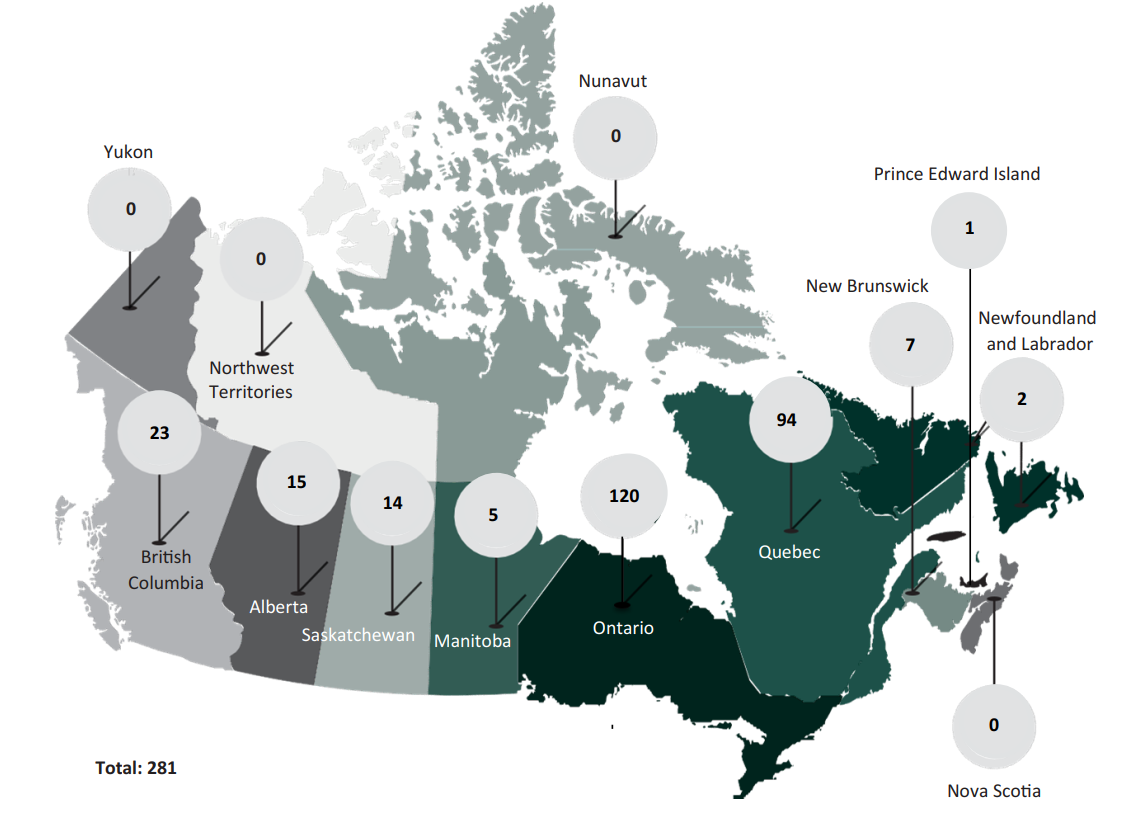
| Province/Territory | Number of applications |
|---|---|
| British Columbia | 23 |
| Alberta | 15 |
| Saskatchewan | 14 |
| Manitoba | 5 |
| Ontario | 120 |
| Quebec | 94 |
| New Brunswick | 7 |
| Newfoundland and Labrador | 2 |
| Prince Edward Island | 1 |
| Nova Scotia | 0 |
| Yukon | 0 |
| Northwest Territories | 0 |
| Nunavut | 0 |
| Total | 281 |
| Decision | Number | % | Total Fair Market Value |
|---|---|---|---|
1 Includes decisions where the average of more than one appraisal is taken as the fair market value. 2 If CCPERB needs additional information before making a decision, it will put the application on hold. CCPERB may also defer an application for administrative purposes. The total cited here represents the number of on hold or deferred files at the end of the fiscal year. 3 If CCPERB concludes that an object does not meet the criteria for outstanding significance, it will refuse the application. 4 If CCPERB determines that it has no jurisdiction to proceed with the review of an application (for example, if CCPERB is not satisfied that the donor or vendor was the owner of the object at the time of donation or sale), the application is deemed inadmissible. |
|||
| Certified at the proposed value1 | 170 | 60.50% | $48,389,275.28 |
| Certified at a lower value | 62 | 22.06% | $13,634,718.23 |
| Certified at a higher value | 28 | 9.96% | $18,836,480.44 |
| Put on hold or deferred2 | 18 | 6.41% | NA |
| Refused3 | 3 | 1.07% | NA |
| Inadmissible4 | 0 | 0% | NA |
| Total | 281 | 100% | $80,860,473.95 |
As part of the certification process, CCPERB makes determinations with respect to the fair market value of the cultural property put forward for certification. Donors or vendors who do not agree with a CCPERB determination of fair market value may request a redetermination within 12 months of the date of CCPERB’s decision. Subsequently, donors or vendors who do not agree with the redetermination of fair market value may appeal the decision to the Tax Court of Canada within 90 days after the day on which the Cultural Property Income Tax Certificate is issued.
In 2023-2024, CCPERB received 4 requests for redetermination.
When a redetermination is made, the original tax certificate is nullified and replaced by a new tax certificate.
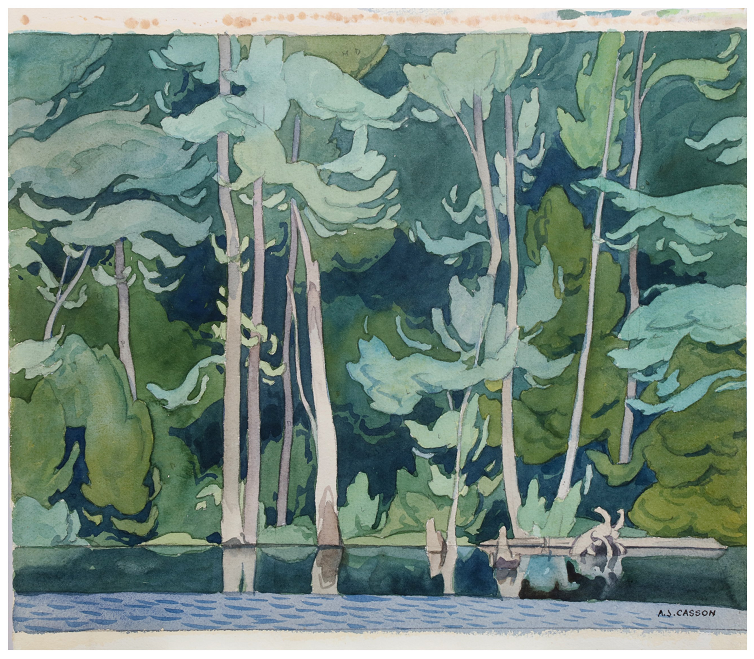
Alfred Joseph Casson (1898-1992)
Shoreline, Baptiste Lake, c. 1955
Watercolour on paper
30.4 x 34.3 cm
Agnes Etherington Art Centre, Queen’s University
Bequest of Joyce Putnam, 2023
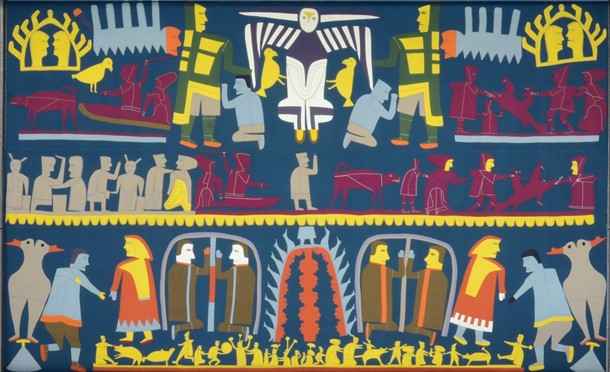
Jessie Oonark (1906-1985)
Untitled Tapestry, 1972
Stroud with felt appliqué and embroidery floss
376 x 600 cm
National Arts Center Corporation
Photo: Gordon King Photography
Certified by CCPERB in 2023
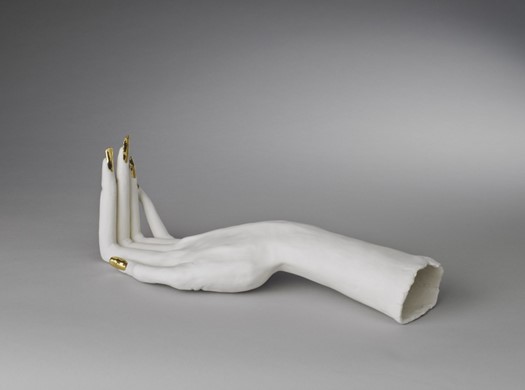
Shary Boyle (b. 1972)
Your Humble Servant, 2014
Porcelain, gold luster
15 x 34 x 14 cm
McMichael Canadian Art Collection
Certified by CCPERB in 2023
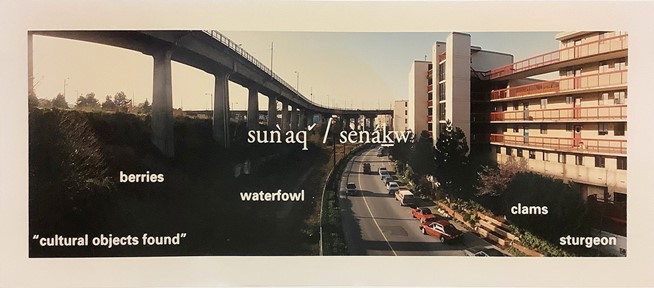
Christos Dikeakos (b. 1946)
Suǹ q /senákw, from the series Sites and Place Names Vancouver, 1990-2015
Chromogenic print, edition 3/3
37.2 x 91.44 cm
Simon Fraser University Gallery
Gift of the artist
Certified by CCPERB in 2023
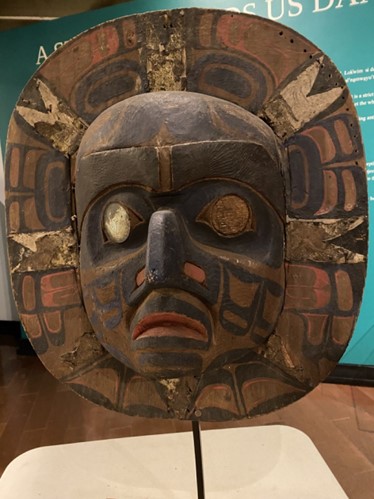
Once known Kwakwaka’wakw Artist
Sun Mask, c. 1860-1870
Wood, mirror, nails, pigments
59 x 52.3 x 18.5 cm
U’mista Cultural Centre
Photo: courtesy of U’mista Cultural Society, 2022, untatalogued
Certified by CCPERB in 2023
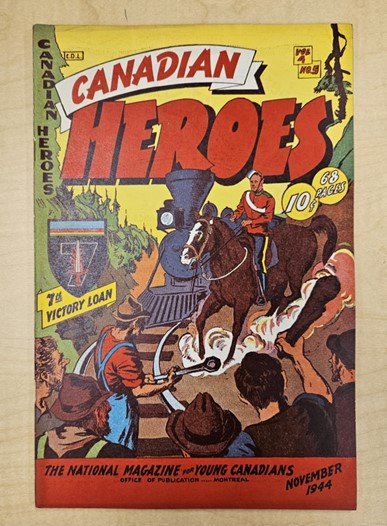
George Menendez Rae (1906-1992)
Cover Comic book Canadian Heroes, Vol. 4, No. 5, Educational Projects,
November 1944
From the Collection of 232 comic books published in Canada between 1941 and 1946, Library and Archives Canada
Certified by CCPERB in 2024
The Review Board underwent a significant transformation over the course of the fiscal year. While it welcomed a new Chairperson, Joanne Stober, it had to say goodbye to a number of key members, including its Chairperson for the past seven years, Sharilyn Ingram, whose term came to an end in May 2023.
These departures were counterbalanced by the arrival of several members, of various backgrounds and expertise, including the afore-mentioned Chairperson, and Daniel Chouinard, who both have years of experience in the archival fields, and the welcomed return of a previous member, Monte Clark, who had served on the Review Board from 2016 to 2021. As well, Stephen Borys, Director and CEO of the Winnipeg Art Gallery and Qaumajuq, and Susan MacKenzie, a practicing attorney specializing in Criminal Defence and First Nations concerns, joined the Review Board, bringing diverse experiences and points of view to ensure, as always, a balance of perspectives in its deliberations.
As previously reported, CCPERB has undertaken an exploration of the manners by which it can support the United Nations Declaration on the Rights of Indigenous Peoples (UNDRIP). It continued to engage with stakeholders who have already put in place initiatives in relation to this Declaration and, further to the dedicated work of a CCPERB working group, the Review Board formalized its commitment to the Declaration through an official statement posted on its website in August 2023.
This statement outlines the Review Board’s engagement with experts in the field and the carrying forward of the information it gathered in the orientation offered to new members. Through this statement, the Review Board also instructed applicants to detail the origin and provenance of Indigenous cultural property. As well, in respect to stakeholders, the CCPERB website is to be updated to the reflect recent Review Board actions pertaining to UNDRIP and this Declaration is to be included as a standing item to each stakeholder engagement opportunity.
The Review Board also remains committed to developing policies in relation to the Declaration, should the need arise.
CCPERB continues to update its guidance to applicants, as well as its tools, in order to increase the efficiency, as well as the accessibility, of its processes. In 2023-2024, one such endeavour was the update of its online portal dedicated to certification applications, now found here. At first glance, the portal may appear unchanged, adopting a similar visual format as its predecessor; however, significant changes were made to simplify the login process, as well as render the steps in respect of a Category B designation status application more efficient and accessible. Further updates of this portal are expected in the near future and invites all feedback on this tool to be transmitted to the Secretariat, at ccperb@tribunal.gc.ca.
CCPERB consists of a chairperson and up to nine other members appointed by the Governor in Council on the recommendation of the Minister of Canadian Identity and Culture.
Members are selected for their expertise in a range of fields relating to cultural property, including professional expertise gained at art galleries, museums, archives, libraries or other collecting institutions in Canada, or as dealers in or collectors of art, antiques or other objects that form part of the national heritage.
Specifically, section 18 of the Cultural Property Export and Import Act establishes membership as follows:
Under the Act, decisions must be made by no fewer than three members, at least one of whom was appointed under the institutional category, and at least one of whom was appointed under the dealer/collector category.
The following table identifies members with active terms during the 2023-2024 fiscal year.
| Member Category | Members in 2023-2024 | Current term |
|---|---|---|
| Public at large | Sharilyn J. Ingram Chairperson Retired academic and museum professional Grimsby, ON |
June 2020 – June 2023 |
| Joanne Stober Chairperson Curator of Visual Culture and Industrial Design Canadian Museum of History Gatineau, QC |
June 2023 – June 2026 | |
| Susan MacKenzie Lawyer Vancouver, BC |
May 2023 – May 2027 | |
| Collecting institution | Stephen Borys Director & CEO, Winnipeg Art Gallery – Qaumajuq Adjunct Professor, History and Business Departments, University of Winnipeg Winnipeg, MB |
February 2024 – February 2028 |
| Daniel Chouinard Retired Archivist, Bibliothèque et Archives nationales du Québec Montréal, QC |
May 2023 – May 2027 | |
| Tzu-I Chung Curator of History, Royal BC Museum Victoria, BC |
May 2021 – May 2024 | |
| Laurie Dalton Director/curator, Acadia University Art Gallery, Adjunct professor, Dept. of History and Classics, Acadia University Wolfville, NS |
January 2021 – January 2024 | |
| Paul Whitney Library and policy consultant, writer, book and art collector Vancouver, BC |
February 2021 – February 2024 | |
| Dealer/collector | Monte Clark Owner and Director, Monte Clark Vancouver, BC |
October 2023 – October 2027 |
| Patricia Feheley Director, Feheley Fine Arts Toronto, ON |
May 2021 – May 2023 | |
| Madeleine Forcier Director, Graff Gallery Montreal, QC |
May 2021 – May 2023 | |
| Jo-Ann Kane Collection Management Consultant Montréal, QC |
February 2022 – February 2025 |
CCPERB meets four times per year. At these meetings, the Review Board considers requests for the review of cultural property export permits, and applications for the certification of cultural property.
In 2023-2024, CCPERB held in-person Board meetings on the following dates:
In addition, it held a virtual Board meeting on the following dates:
CCPERB published a Quarterly Report on its website, in order to provide the public with a statistical summary of formal business during each quarterly meeting.
The Secretariat to CCPERB is part of the Administrative Tribunals Support Service of Canada (ATSSC). The Secretariat supports the Review Board and its applicants by:
CCPERB’s offices are located in the National Capital Region, the traditional unceded territory of the Algonquin Anishinaabe people.
For questions about CCPERB operations or information contained in this Annual Report, please contact:
Canadian Cultural Property Export Review Board
344 Slater Street, 15th Floor, Suite 400
Ottawa, Ontario K1A 0E2
